It seems that we are not the only people who enjoy a day at the beach and a dip in the sea! An article in the scientific journal PLOS One this month (January 2020) suggests that Neanderthals may have collected seashells and even dived into the Mediterranean to gather clam shells for tools.
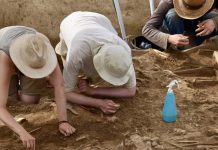
A team led by Paola Villa of the University of Colorado Boulder has been exploring a cave called Grotta dei Moscerini (Cave of Gnats) in the Apulia region of southern Italy. First excavated in 1949, this is one of two Neanderthal sites in Italy where researchers have found what appear to be worked tools made from clam shells and volcanic rock, dating back 100,000 years.

The team examined 171 shells, many of which had been modified for use as scrapers. They found that nearly three quarters had opaque and slightly abraded exteriors, as if they had been sanded down over time. This is what you would expect to see in shells that had washed up on a sandy beach. However, the team also found a large number of pumice stones which could have been used as abrading tools.
The remainder of the shells had a shiny, smooth exterior and were also slightly bigger, suggesting that they had probably been plucked directly from the sea floor as live animals. According to Dr. Villa: “It’s quite possible that the Neanderthals were collecting shells as far down as four metres (13ft). Of course, they did not have scuba equipment.”
Archaeological data from other sites in Italy, France and Spain confirm that shell fishing was a common activity of Neanderthals.
Text Alun Harvey