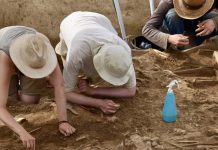
Karahunj, often called the Armenian Stonehenge, lies about 230 kilometres from the Armenian capital Yerevan, in the region of Syunik, not far from the town of Sisian. Close to the town is a high plateau where a 500-metre long row of stones lies as if they were laid out in a pattern. The stones vary in height up to 3 metres high and some of them weigh up to 10 tons.

According to astronomers and other scientists, Karahunj is 7,500 years old, which is 3,000 years older than Stonehenge. It is also much older than most other known civilisations, such as those in Egypt and Sumeria. What makes this really remarkable is that an unknown civilisation had an understanding of astronomy and boasted the oldest astronomical observatory in the entire world.

This unique megalithic monument has a number of other remarkable characteristics. In 84 of the stones there are small bored holes which were carefully placed at various different angles. They were positioned so that they form diverse angles in relation to the horizon and the night sky. It is thought that they may possibly have formed some kind of telescope but their purpose remains a mystery.
Investigations also show that the stones themselves were carefully placed so that they matched the constellation of Cygnus, the Swan. This constellation was also of great importance in other ancient cultures and was considered the entrance and exit to and from heaven. Some experts believe that this site might have been the cradle of astronomy which later spread from here through the entire world.
Meer informatie zie https://armeniadiscovery.com/en/articles/the-armenian-stonehenge-zorac-karer


Text Harrie Wolters
Translation Alun Harvey