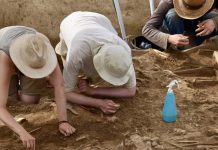
Findings recently published in the journal Science suggest that cavemen were smarter than we thought they were. A study of Neanderthal tools found in the Dordogne region of France has revealed that the tools and their handles were held together by a multi-component adhesive – in other words, glue.
The tools were discovered in the last century at the archaeological site of Le Moustier but have now been re-examined by a team led by scientists at the University of Tübingen in Germany. Dr Ewa Dutkiewicz of the National Museums in Berlin, said: “Taking into account the overall context of the finds, we assume that this adhesive material was made by Neanderthals.”

Fæ, CC BY-SA 3.0 <https://creativecommons.org/licenses/by-sa/3.0>, via Wikimedia Common s
Le Moustier
The archaeological site of Le Moustier consists of two rock shelters in a cliff face.

The upper cave, discovered in the 1860’s, yielded a rich assemblage of stone tools from the Palaeolithic Period. The lower cave, excavated in the early 20th century, contained two immature Neanderthal skeletons which have provided significant information on growth patterns in Neanderthals. One of the most complete Neanderthal skeletons in existence, the fossils are amongst the best preserved in the world.

The first skeleton, Le Moustier 1, is an adolescent of the species Homo neanderthalensis. The remains include most of the skull and several major long bones. Le Moustier 2, discovered in 1914, is the largely complete skeleton of a newborn child. Both skeletons date to between 40,000 and 50,000 years ago.
Analysis shows that various features of adult Neanderthals became obvious at different stages of development. For example the infant’s skeleton already exhibits facial proportions that would eventually form the pronounced midface projection and swept-back cheek regions of the adult Neanderthal. The adolescent skeleton exhibits the large front teeth, the projecting midface, and the long, low, rounded braincase of the adult Neanderthal. Its limb bones, although small, are already robust; its brow region, however, is only slightly developed.
UNESCO World Heritage Site
Since 1979 Le Moustier has been part of a UNESCO World Heritage Site collectively known as the Prehistoric Sites and Decorated Caves of the Vézère Valley. The entire UNESCO site is of major archaeological importance and comprises more than 150 known Palaeolithic sites, the most famous of which is Lascaux with its cave paintings. Le Moustier itself has also given its name to a prehistoric period – the Mousterian
Source: Daily Telegraph and Wikipedia
Text Alun Harvey