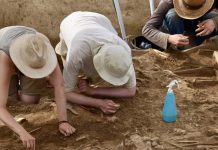
According to a recent article in the Nature journal, archaeologists in Spain have found the fossilised fragments of an unknown human ancestor. The fragments, found in 2022, consist of an adult jaw and cheekbone and have been dated to between 1.1 and 1.4 million years ago. They were first thought to belong to the species Homo antecessor, an early human known to have inhabited the area about 860,000 years ago. However, the shape of the face resembles that of the far earlier and more primitive Homo erectus, a species which arrived in Europe about 1.8 million years ago.
If this is true, then the fragments would be the earliest hominid fossil found so far in Western Europe. However, the fossils are still being studied and have not been definitively identified. In the meantime, it has been provisionally classified as Homo affinis erectus.

The fossils were found in the Sima del Elefante, one of several cave complexes at Atapuerca, near Burgos in northern Spain. The caves of Atapuerca were first discovered during the construction of a deep cutting for a new railroad in the 1890s. Excavations over more than 60 years have unearthed a wealth of finds proving continuous human occupation over an astonishing 1,200,000 years. This represents a timeline stretching from early humans and hunter-gatherers to the Bronze Age.
Human finds in the caves include 5,500 skeletal remains, representing 28 individuals, dating from the Middle Pleistocene period around 350,000 years ago. One of the most important finds here was the skull of Homo heidelbergensis, dating to between 600,000 and 400,000 years ago. In areas outside the caves, about 6,000 animal bone fragments have been found ranging from pigs and horses to aurochs, beaver and hippopotamus.
In 2000, Atapuerca was designated a UNESCO World Heritage Site.

Visiting Atapuerca
Atapuerca has three main natural settings which can be visited on guided tours, bookable in advance – la Sima del Elefante (The Elephant Pit), Galería (The Gallery), and la Gran Dolina.
Visitors meet at the Site Access Centre, known as CAYAC, which contains a permanent exhibition called “Sierra de Atapuerca – natural and cultural heritage.” From here shuttle buses take them to the site itself. Visitors enter along the original Railway Cutting, where the first remains were found during digging around 1890.
Experimental Archaeology Centre
Nearby is an Experimental Archaeology Centre named CAREX, which consists of two zones. The outdoor zone takes visitors on a chronological tour to familiarise them with the evolution of technological innovations in the course of human history. In the indoor zone an exhibition explains the major research areas of Experimental Archaeology, divided into ten themes: 1) stone knapping, 2) toolmaking, 3) the use of tools, 4) the production of fire, 5, 6 and 7) evolution of shelter through prehistory, 8) pottery 9) weaving and basket making, and 10) art and musical instruments. CAREX is part of the international experimental archaeology network EXARC.
Museum of Human Evolution, Burgos
More than 200 finds from the site are on display in the Museum of Human Evolution in the centre of Burgos, 15km from the site.

Sources:
https://en.wikipedia.org/wiki/Archaeological_site_of_Atapuerca
https://www.atapuerca.org/en/apartado/1989/sierra-de-atapuerca-sites
Text Alun Harvey