A complex ritual landscape in Tangier
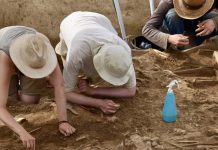
On the northwesternmost tip of Morocco, the Tangier Peninsula, archaeologists have uncovered a series of significant prehistoric sites. The international research team found, among other things, three burial sites, a number of shelters with rock carvings and the remains of standing stones – all indications of a complex and varied ritual landscape which was previously largely unknown.
The region, which lies south of the Straits of Gibraltar, has for long been a subject of discussion among scientists. We still don’t know how long the area has been inhabited or how ritual and social structures evolved there. Until recently virtually no archaeological work has been directed towards burial practices or indeed what use was made of the landscape in this remote part of North Africa.
In a study published on 13 May 205 in the African Archaeological Review, researchers draw attention to this omission. They suggest that “despite 200 years of research, the funerary and ritual landscapes of later prehistory in North Africa to the west of Egypt belong to the least known and understood areas around the whole Mediterranean Sea.”
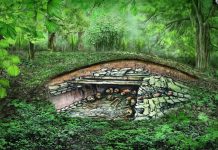
During their fieldwork, the team focussed on sites dating from the period between 3000 and 500 BC. They discovered three burial sites, some of which contained cist graves: spaces dug out of the rock, some closed with stone slabs. The labour involved in digging such graves would have demanded considerable hard work and expertise. “Their construction probably required a considerable investment of time and effort,” according to Hamza Benattia, lead author of the study and graduate of the University of Barcelona.

One of these graves produced an unusual and important find. Radiocarbon dating of human remains found in a cist grave shows that it was dug around 2000 BC. This is the earliest carbon dating of a cist grave in Northwest Africa, making the find even more significant.
Close to the burial sites the team found about a dozen hiding places in niches in the rock which contained rock drawings. The artworks displayed a wide range of geometric motifs – rectangles, dots, wavy lines – and anthropomorphic figures which possibly represent humans or gods. There were also so-called “cup marks”: saucer-shaped indentations in the rock, sometimes arranged in patterns such as circles or parallel lines.
Among the most striking images were eight inverted triangles above each other, a motif which is locally known as ‘bi-triangulars’. This type of drawing is also found in Iberian contexts, where it is often interpreted as an anthropomorphic, possibly female, representation. Another recurring shape was a rectangle with dots and lines – similar to rock drawings found in the Sahara.
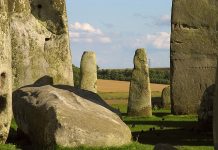
The research team also came across the remains of standing stones in a number of locations. Some stones stood together in clusters and were more than 2.5 metres high. These megaliths point upwards towards the sky and are often interpreted as territorial markings. Benattia suggests that in fact they also served as meeting places or centred of ritual activities.

According to the research team, the combination of burial sites, rock drawings and megaliths suggests a refined and many-branched ritual landscape. The researchers concluded that “The ritual landscape of the peninsula of Tangier is far more complex and extended than previously thought”. They draw parallels with late prehistoric cultures in the south of the Iberian Peninsula and the Sahara.
These discoveries not only offer new insights into prehistoric Northwest Africa, but also underline the necessity for further archaeological research in a region which has, until now, been ignored.
Translation Alun Harvey