Background
The Dufuna canoe was found in the village of Dufuna, which is located between Potiskum and Gashua in North Eastern Nigeria. Dufuna is now officially in Yobe State, which was carved out of Borno State in 1991. This is still a farming area and the city of Potiskum has the largest cattle market in Africa.

The canoe was discovered in 1987, at a depth of 4.5 metres, by a Fulani cow herdsman who was digging a well. The site was first excavated by staff of the University of Maiduguri who carried out radiocarbon tests. Further dating tests, carried out later at two German laboratories, dated the canoe to around 6,000 to 6,500 BC. This makes it the second oldest boat found to date, the oldest being the Pesse canoe found in the north of the Netherlands.
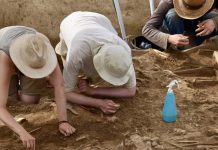
In 1994, a joint archaeology team from Germany and Nigeria excavated the Dufana site and found that the waterlogged canoe was resting on a sandy bed with layers of clay between it and the surface. It was this position which protected it in an oxygen-free environment. The canoe was carefully dug out and removed by fifty labourers over a period of two weeks. It was found to measure 8.4 meters in length, 50 centimetres wide and 5 cm thick. Examination showed that the bow and stern had been skilfully worked to points by stone tools resembling axes and picks.

The village of Dufuna lies roughly 200 kilometres from Lake Chad, a freshwater lake with an important wetland ecosystem. The size of the lake now fluctuates seasonally between 2,000 and 5,000 sq. km. but in the 19th century it was known to measure 28,000 sq.km. Scientists believe that it would have been even larger in the distant past, which means that the area around Dufuna could have been part of the lake’s flood plain.
The canoe is currently displayed at the museum in the state capital of Damaturu.