Stonehenge is the best known prehistoric stone circle in Britain, but it is not the largest. Or even the second largest. First place goes to Avebury Stone Circle which, with a diameter of 330 metres (1,088 ft), is not only the largest in Britain but also the largest in Europe.
The monument in second place is far less well-known, partly because it is less spectacular and partly because it lies off the beaten track. As a result, the Stanton Drew stone circles receive far fewer visitors than Avebury or Stonehenge.

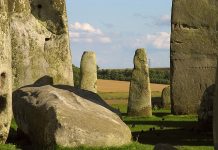
The small village of Stanton Drew lies 13 km (8 miles) south of Bristol. Just outside the village are three stone circles, one large and two small. The largest is called the Great Circle and has a diameter of 113 m (370 ft). Originally it probably consisted of 30 stones, of which 27 survive today, and was probably surrounded by a ditch with an outer diameter of 135 metres (443 ft). An entrance 40 metres (130 ft) wide is visible on the north east side.

The two smaller circles stand to the northeast and southwest of the Great Circle. The North East Circle is 30 metres (98 ft) in diameter and probably consisted of 10 or more stones, of which 8 survive today. The South West Circle is 43 metres (141 ft) in diameter, and has 12 surviving stones.
Within the North East Circle, there once stood a square of four enormous timber posts. Sometimes called ‘square-in-circle’ or ‘four-poster’ sites, they are typical of the late Neolithic period. It is unclear whether these were buildings, raised platforms or some kind of ceremonial structures.
It is thought that the circles were erected as ceremonial monuments around 2500 BC, during the late Neolithic period. The stones have never been excavated but geophysical work carried out by English Heritage in 1997 revealed nine concentric rings of postholes. More than four hundred pits, 1 metre across and at 2.5 metre intervals, stood in rings at the site.
Both John Aubrey in 1664 and William Stukeley in 1723 recorded the presence of an avenue extending to the north-east towards the River Chew. On the other side of the river was another standing stone (now recumbent) called Hautville’s Quoit, which aligned with the centres of the Great Circle and the southern circle.

The Cove
In the centre of the village, in fact in the garden of the village pub, The Druid’s Arms, is a group of three large stones called The Cove. These stones are around 1,000 years older than the stone circles, dating from 4000 – 3000 BC.

Mineralogically, the irregular lumps of stone here are different to those in the circles. The cove stones are Dolomitic Conglomerate, probably brought here from the Mendip Hills about 3 miles south-west. The stones are of different heights, the ones in the north east being 4.4 metres (14 ft), those in the south west 3.1 metres (10 ft), and the ones in the north east 1.4 metres (4 ft 7 in).
Under the stones in the Cove lies a long barrow burial chamber, which is roughly one thousand years older than the standing stones.
Sources
https://en.wikipedia.org/wiki/Stanton_Drew_stone_circles
https://www.english-heritage.org.uk/visit/places/stanton-drew-circles-and-cove