Chalcolithic
The Chalcolithic was an archaeological period between the Neolithic and Bronze Ages which saw the transition from stone-working to copper-smelting and the beginnings of metallurgy. One important centre for this new medium was the steppe of Eastern Europe, stretching roughly from the northern shores of the Black Sea to an area around the Caspian Sea. First inhabited around 6,000 BC, from 3,350 to 2,300 BC the region was an important centre of human settlement in Europe.
Arguably the most important wave of migrants to the area was the Vučedol Culture which flourished between 3000 and 2200 BC in an area on the right bank of the River Danube. They settled close to mountain ranges where they could source copper to use in making tools and weapons. The growth in demand for copper led to the Vučedol Culture expanding its territory until, at its peak, it covered 14 of today’s European countries – the Czech Republic, Slovakia, Austria, Hungary, Romania, Slovenia, Italy, Croatia, Bosnia and Herzegovina, Serbia, Montenegro, Kosovo, Albania and even one settlement in Eastern Greece.
Vučedol

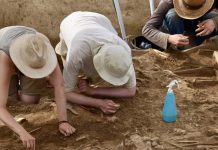
One major centre was present-day Vučedol in today’s Croatia, from which the culture takes its name. It is estimated that the site was once home to about 3,000 inhabitants. The site was first excavated in 1897.
The inhabitants lived in thatched wattle-and-daub houses built on hilltop sites surrounded with palisades. The houses had floors of burned clay and circular fireplaces. The Vučedol people were hunters, fishermen and farmers, as well as copper-smiths.
Vučedol Dove
One of the most famous pieces produced by the Vučedol Culture is a ritual vessel in the shape of a dove, made between 2800 and 2500 BCE. Made from baked clay, it is 19.5 cm high. Incised on its neck, wings and head are three symbols of double axes and a necklace. The piece takes its name from an unusual crest on its head which gives it the appearance of a domesticated dove.

Astral calendar

Another famous piece is a ceramic pot dated to 2600 BC, which is decorated with an astral calendar. The year is shown as a precise sequence of constellations beginning at dusk on the first day of spring. Because of the local climatic conditions, the region experiences four annual seasons. Each of the four lateral bands on the vessel represent the four seasons, starting with spring at the top. Each band is divided into twelve boxes, which experts believe to be 12 periods or “weeks” for each season. Each box contains an ideogram of celestial objects which lie at a certain point on the horizon just after sunset. The pictographs in the boxes represent: Orion, the Sun, Cassiopeia, Cygnus, Gemini, Pegasus, and the Pleiades.
Both the Vučedol Dove and the Astral Calendar are on display at the Vučedol Culture Museum in Croatia.
Sources